Kindergarten Learning Activities: A Workbook for Early Development
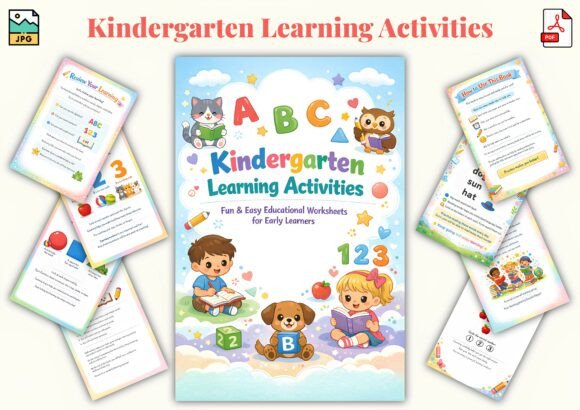
In the world of early childhood education, the difference between a child struggling to engage and one who is eager to learn often comes down to presentation. Kindergarten Learning Activities represents more than just a collection of worksheets; it is a carefully curated educational resource designed to bridge the gap between play and structured learning. For parents, teachers, and homeschooling entrepreneurs looking to create meaningful educational experiences, this 30-page workbook offers a compelling solution that balances visual appeal with pedagogical value.
The design philosophy behind this resource prioritizes accessibility and engagement. With a clean 6×9 inch layout, the workbook adheres to standard printing dimensions while maintaining a digital-first mindset. This specific sizing ensures that whether you are producing physical copies for a classroom or distributing digital PDFs for home use, the content remains legible and comfortable for small hands. The absence of cluttered backgrounds and the use of soft pastel colors reduce cognitive load, allowing young learners to focus on the task at hand rather than being distracted by chaotic visuals.
Visual Personality and Design Characteristics
When analyzing the aesthetic of Kindergarten Learning Activities, the first observation is its friendly, approachable nature. The workbook utilizes a cartoon-style visual language that feels inviting rather than intimidating. This is crucial for kindergarten-aged children who are just beginning to associate books with positive experiences. The color palette is intentionally soft, employing pastels that soothe rather than overstimulate. In a market often saturated with neon greens and aggressive primary colors, this choice demonstrates a sophisticated understanding of child psychology and modern educational trends.
The typography plays a pivotal role in establishing this tone. The font choices are not merely decorative; they are functional tools for literacy development. The typeface features kid-friendly characteristics, such as clear letterforms and distinct shapes that help children differentiate between similar characters like 'b' and 'd'. The layout avoids empty spaces, ensuring that every page is balanced with engaging content. This density of activity prevents boredom while maintaining a sense of order that helps children feel secure in their learning environment.
The inclusion of creative drawing exercises alongside traditional tracing and counting tasks suggests a holistic approach to design. By integrating artistic expression with academic drills, the workbook acknowledges that creativity and logic are not mutually exclusive but rather complementary skills. This integration is evident in the matching activities and word-picture connections, which require children to process information visually and linguistically simultaneously.
Strategic Applications for Educators and Creators
For professionals in the publishing and education sectors, the versatility of this workbook makes it a valuable asset. The 6×9 inch format is industry-standard for trade paperbacks and workbooks, making it immediately compatible with major print-on-demand platforms like Amazon KDP. This compatibility lowers the barrier to entry for self-publishers who wish to create their own educational lines without needing complex custom formatting.
Beyond simple printing, the high-quality PDF and JPG file formats included offer flexibility for various digital marketing strategies. Content creators can extract individual pages to create social media graphics that demonstrate the product's value before a purchase is made. Teachers can project these images onto interactive whiteboards for whole-class instruction, while homeschooling families can utilize the digital versions for tablet-based learning. The fact that the files are ready for commercial use allows designers to integrate these assets into larger curriculum bundles or subscription boxes without worrying about licensing restrictions.
The workbook also serves as an excellent case study for brand identity in the educational niche. By consistently applying the same visual style across all 31 pages, the resource builds a recognizable "look" that signals quality and reliability. When parents see a consistent aesthetic, they are more likely to trust the material as a legitimate learning tool. This consistency extends to the font pairing strategy, where the playful display elements are balanced with highly readable body text, ensuring that instructions remain clear even for emerging readers.
Evaluating Readability and Functional Typography
At its core, the success of Kindergarten Learning Activities lies in its attention to readability. In editorial design and web design alike, the primary function of a typeface is to communicate effectively. Here, the design team has prioritized legibility above all else. The letters are spaced generously enough to prevent crowding but close enough to maintain a cohesive line rhythm. This balance is essential for children who are still developing fine motor skills and tracking ability.
The inclusion of letter tracing and number recognition sections highlights the importance of motor skill development. The font used for these exercises must be robust enough to handle repeated strokes without losing clarity. The workbook achieves this by using a sans-serif style that is easy to trace, avoiding unnecessary flourishes that could confuse a child trying to replicate the shape. This practical consideration underscores the idea that good design in education is invisible; it works so well that the child focuses entirely on learning, not on deciphering the medium.
Furthermore, the workbook's structure supports differentiated learning. Because the activities range from simple word reading to sentence building, the design accommodates varying levels of proficiency within a single classroom or household. The visual hierarchy guides the eye naturally from the title to the instruction, then to the activity itself. This logical flow reduces the need for constant adult intervention, fostering independence in young learners.
Practical Implementation and Licensing Considerations
For marketers and entrepreneurs looking to expand their product offerings, the Kindergarten Learning Activities workbook provides a solid foundation. The commercial license allows for the creation of derivative works, meaning you can adapt the content to suit specific themes or curricula while retaining the core design integrity. Whether you are designing packaging for educational toys or creating a series of blog posts about early literacy, having access to high-quality design assets saves significant time and resources.
When evaluating such a resource, it is important to look beyond the surface aesthetics. Ask how the design influences the user experience. Does the font encourage long-term engagement? Is the layout scalable for different devices? Does the color scheme support the intended emotional response? In this case, the answer to all these questions is a resounding yes. The workbook demonstrates how thoughtful design can transform a standard educational tool into an exciting journey of discovery.
Ultimately, Kindergarten Learning Activities stands out because it respects the intelligence and curiosity of the child. It does not talk down to the learner but instead invites them into a world of exploration through carefully crafted visuals and clear, accessible text. For anyone involved in the creation of educational materials, this workbook serves as a benchmark for what happens when functionality meets creativity.